




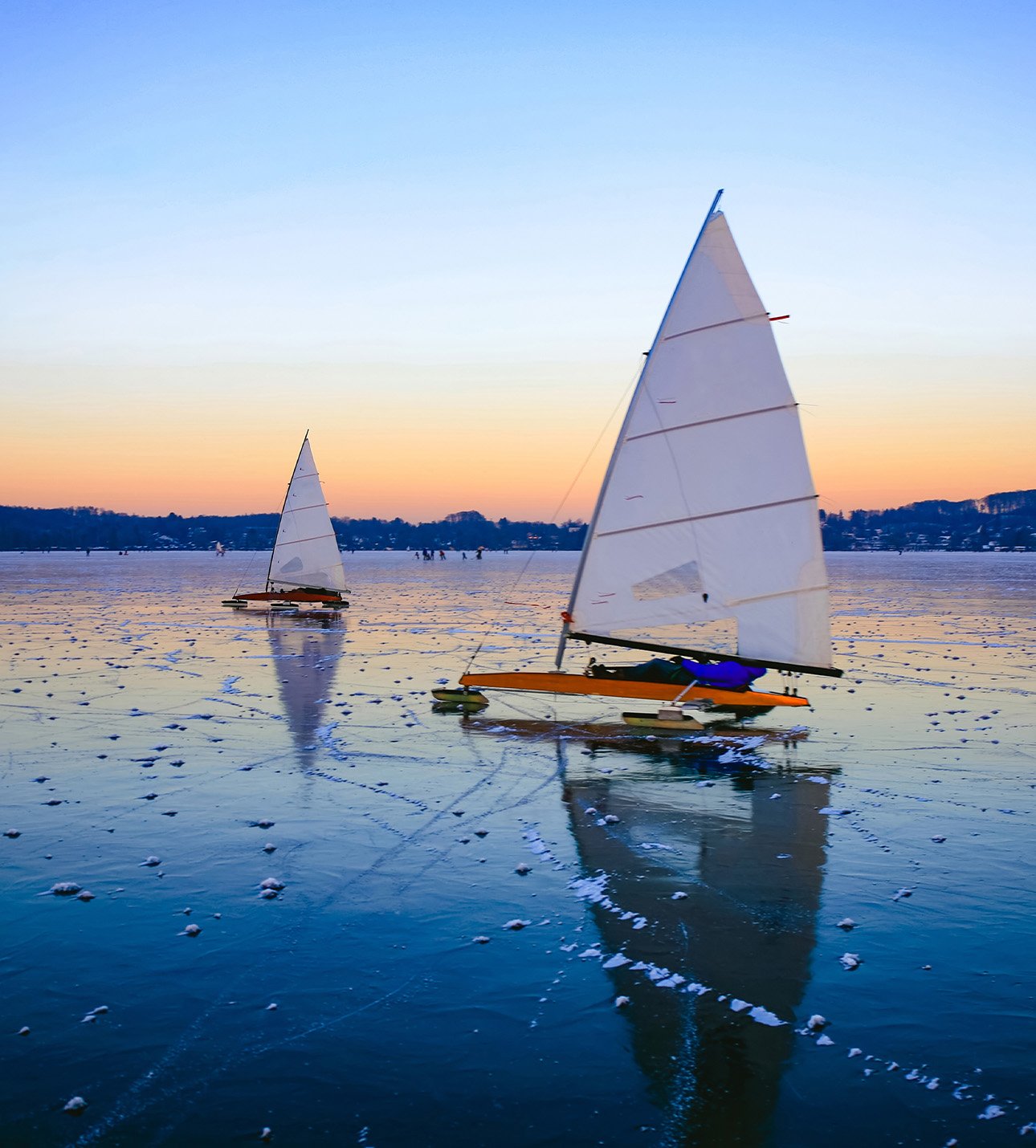
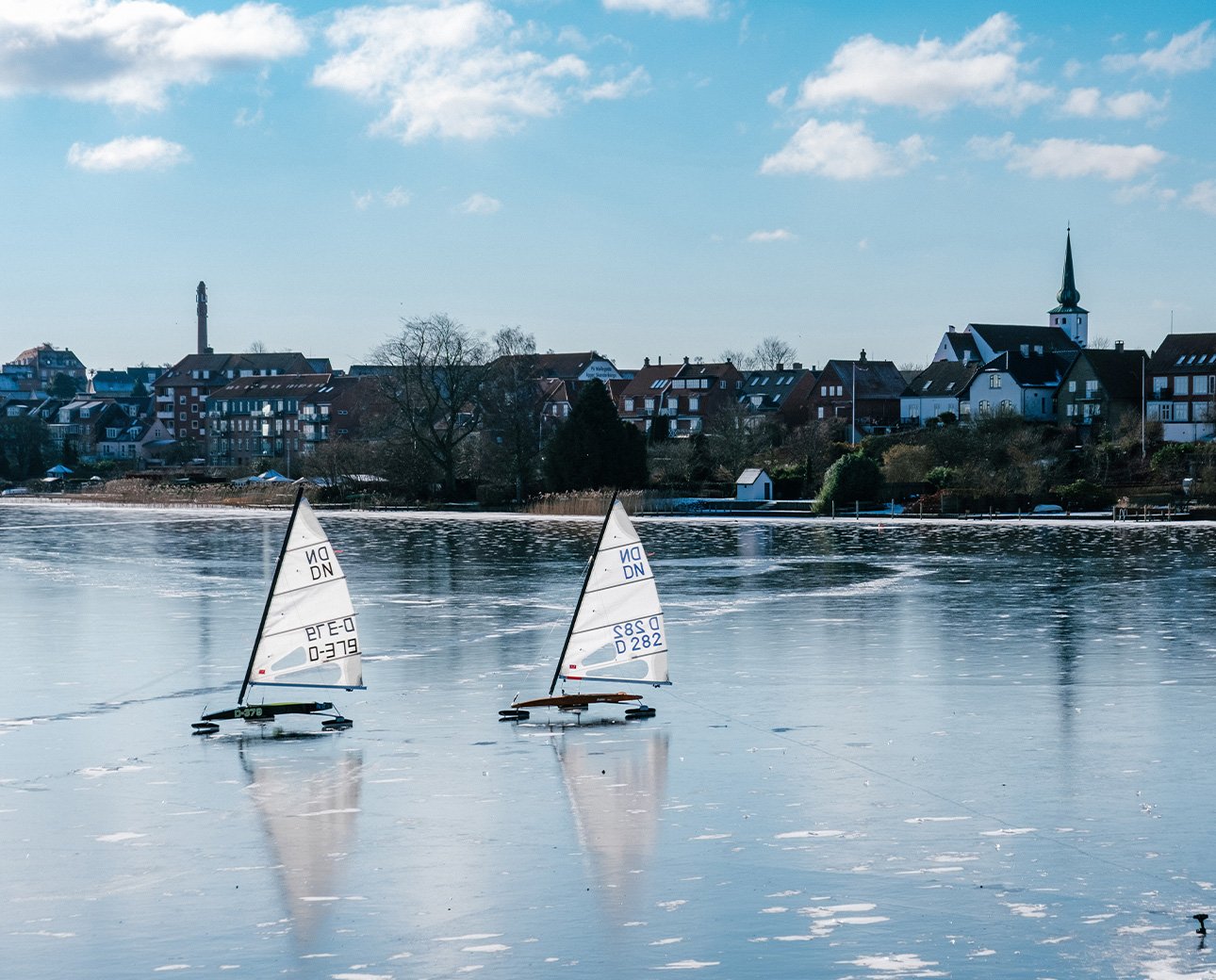
WHEN KING WINTER SEIZES POWER, there is a SMALL GROUP OF SPORTSMEN who keep a particularly close eye on the thermometer and the wind gauge. They might even tap the barometer one extra time to see whether the frost has truly taken hold so they can LOAD THE ICEBOAT ONTO THE TRAILER AND SET COURSE FOR THE NEAREST ICE-COVERED LAKE.
Formula 1 on Ice
The warmer climate is also taking its toll on the number of Danish ice sailors. In the past, there were perhaps 200–300 active members of the DN club, which was a specialist club under the Danish Sailing Union. Today, it has been disbanded. Perhaps not surprisingly. In fact, no Danish championship has been held since 2011. But that does not mean Georg Juelsgaard has given up. As recently as February this year, he took part in the European Championships in Finland.
Although he got his adrenaline rush, the results were nothing to write home about.
Shattered his boat
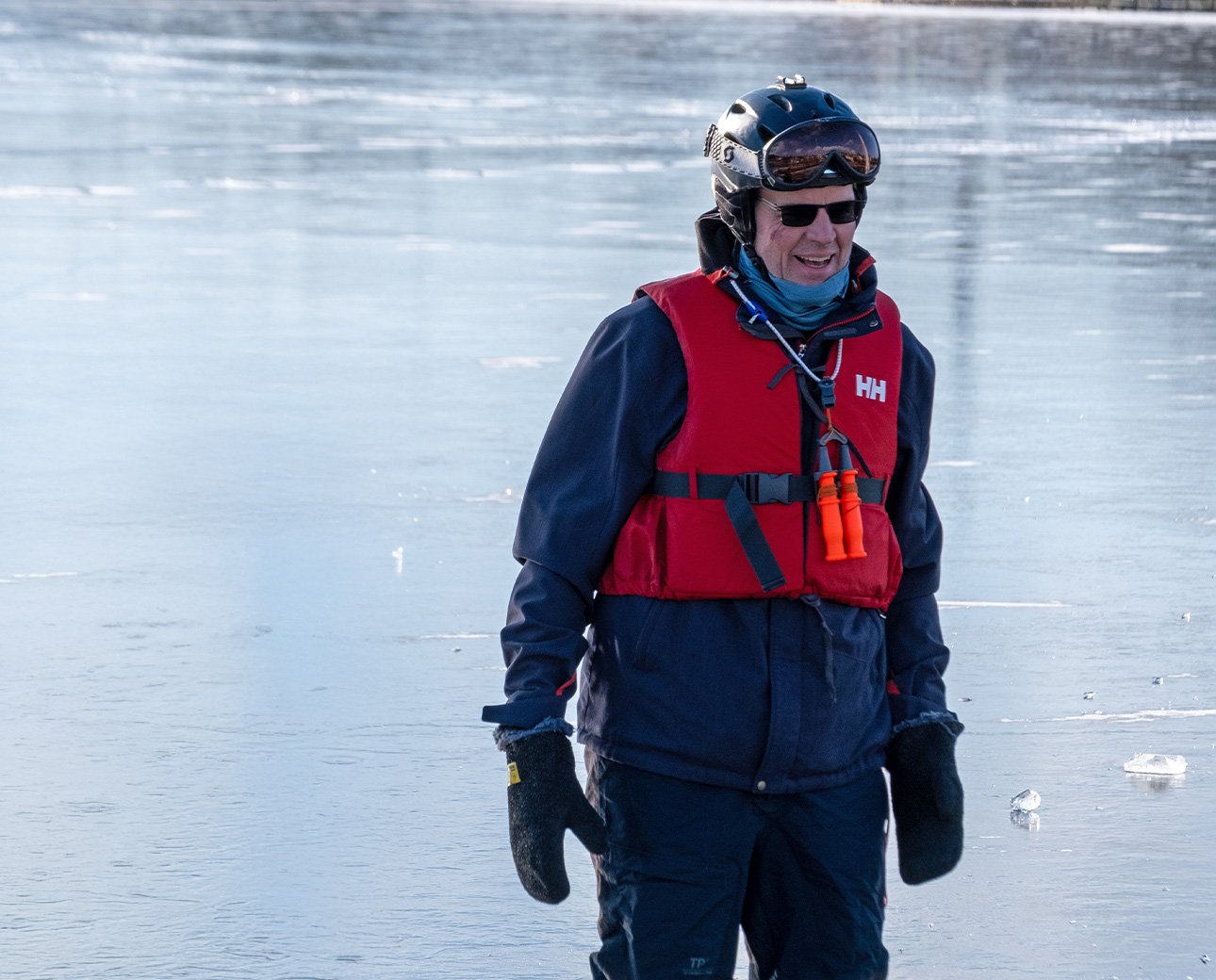
“I only managed to complete five heats before my boat hit a pressure ridge and was torn apart. Fortunately, I wasn’t injured. But for the rest of the event, I was a spectator,” says Georg Juelsgaard, who in his daily life works in production management and is responsible for workplace safety at a packaging factory in Horsens.
Georg Juelsgaard has spent the past 16 years searching for the ultimate adrenaline rush on frozen lakes. He built his first iceboat back in 2010. However, it never made it onto the ice. He had to admit that it could not measure up to a professional iceboat built for racing on ice. It took two years before he accepted that a specially built boat was required in order to sail on ice.
Deep-frozen lakes and seas have for centuries prompted fishermen to haul their boats onto the ice during winter. Many may also remember images from history books of large rowing boats transporting passengers across the Great Belt during the icy winters of the occupation. But there is a world of difference compared to today’s iceboats, which weigh next to nothing and can reach top speeds of over 100 km/h.
“It’s the rush that makes ice sailing something extraordinary,” says Georg Juelsgaard, and continues: “So when winter arrives and the forecast points to freezing conditions, the phone chains start up. We call around among us iceboat sailors to find out whether there’s ice on the lakes. It’s a very short window we have if we want to sail here at home. A few days, maybe a week.”
So when the ice reports start coming in, he drops whatever he’s doing, packs the car, and sets off. Often the journey goes to Sweden, where he’s happy to drive the more than 900 kilometers to Stockholm to find good ice. But occasionally, the nearly 200 Danish ice sailors are lucky enough that winter conditions take hold here at home.
“Two years ago, we had a few days when there was enough ice on Arresø in North Zealand. Fortunately, my family has gotten used to me heading off as soon as the opportunity arises. You have to make the most of the wind and the cold when they’re there.”
It’s all about speed
For Georg Juelsgaard, it’s about the speeds out on the ice. About acceleration. And not least the camaraderie that emerges when he meets like-minded people at a frozen Danish lake or at international competitions held across Europe, such as the European Championships in the DN class, which is the official designation for iceboats.
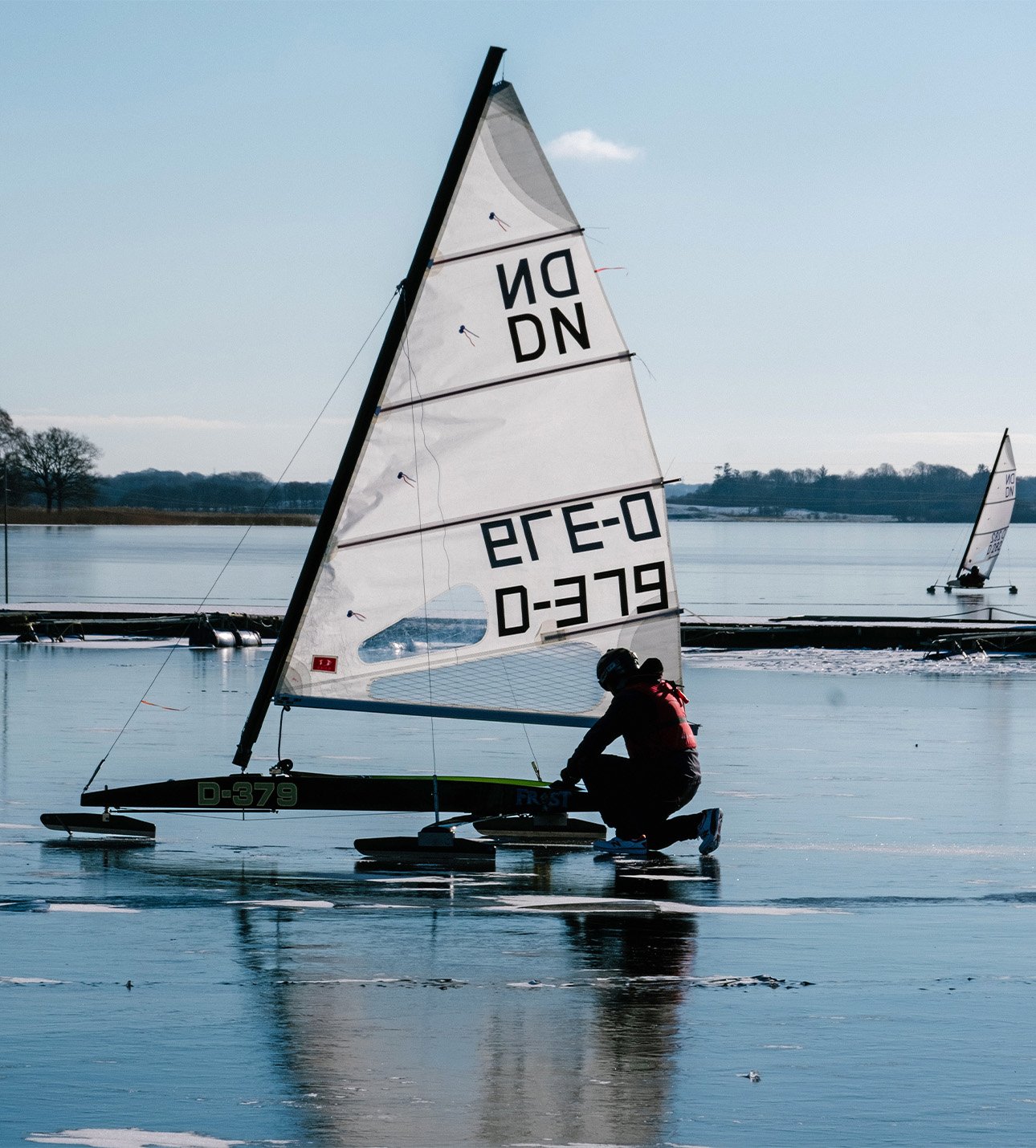
The name dates all the way back to 1936, when the American newspaper Detroit News, in the midst of the Great Depression, announced a competition to design an iceboat that could be built at home in a workshop.
“It resulted in a slender hull, a wooden mast, and three runners. The optimal speed these boats could reach was just before the mast snapped. Over time, carbon fiber replaced the wooden masts. They are far more flexible. In addition, the boat’s hull is now clad in fiberglass.”
A modern iceboat easily costs around 75,000 Danish kroner. The major expense, however, is the runners, which cost ice sailors between 6,000 and 10,000 kroner per set.
Once you’ve also invested in the necessary safety equipment, you’re ready to compete in events held across Europe and the United States. It’s at the competitions that the real rush comes.
“All the boats are lined up along a long starting line. When the start goes, each sailor grabs their boat and runs it up to speed. When you can’t keep running any longer, or you’re out of breath, you jump onboard and sail toward the top mark, which is 1.8 kilometers from the bottom mark where you turn. Each heat consists of three laps of the course,” says Georg Juelsgaard.
He hopes the coming winter season will also bring frozen lakes here at home. Otherwise, he’s ready to drive to the nearest ice he can find, in Sweden, Finland, or perhaps Germany. Because there is almost nothing that can keep him from chasing his adrenaline rush out on the ice.