




How is an exclusive mechanical watch actually made? Join us on a visit to Panerai’s manufacture in Neuchâtel, where the iconic diving watches are created from raw blocks of brass, delicate mechanics and modern technology – before eventually finding their way onto the wrists of enthusiasts, collectors and celebrities around the world.
In front of me lies a lump of raw brass. It weighs just over a hundred grams, is roughly machined and looks remarkably like something that might have fallen off an old radiator. But in three months’ time, that same piece of metal will be sitting on the wrist of a wealthy businessman in New York – having cost him DKK 300,000. Welcome to Panerai’s manufacture in Neuchâtel.
You can visit Panerai in Neuchâtel yourself by booking a 2.5-hour guided tour via the website. It costs CHF 70 (just under DKK 600), and there is room for only eight people on each tour, so booking early is recommended. Find out more at panerai.com
In front of me lies a lump of raw brass. It weighs just over a hundred grams, is roughly machined and looks remarkably like something that might have fallen off an old radiator. But in three months’ time, that same piece of metal will be sitting on the wrist of a wealthy businessman in New York – having cost him DKK 300,000. Welcome to Panerai’s manufacture in Neuchâtel.
You can visit Panerai in Neuchâtel yourself by booking a 2.5-hour guided tour via the website. It costs CHF 70 (just under DKK 600), and there is room for only eight people on each tour, so booking early is recommended. Find out more at panerai.com
Born for Life as a Frogman
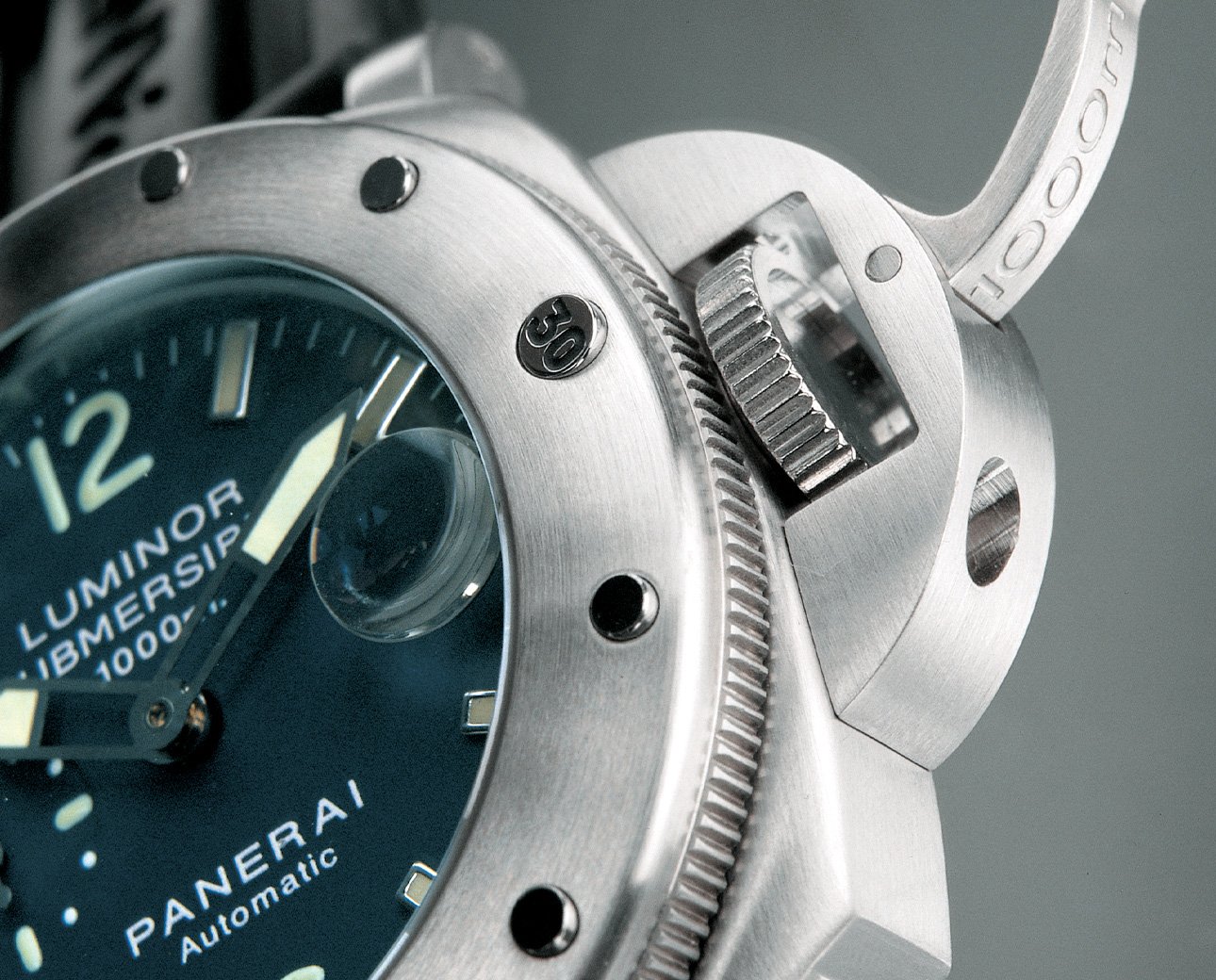
It is a sunny but slightly hazy day as I make my way up the winding streets towards Panerai’s production facilities – its manufacture, as it is known in the watchmaking world. I am here for a tour and to meet CCO Jérôme Cavadini to learn more about the brand behind some of the most iconic diving watches on the market. Panerai watches are easy to spot, even from a distance, with their rounded cases, minimalist dials and, not least, the large crown-protecting bridge, which together create a completely different design language from that of, for example, Rolex and Omega. There is a reason for this: Panerai’s watches were born in the 1930s for the demanding life on the wrists of Italian frogmen and therefore had to withstand use under extreme conditions in dark seawater.
That is probably not the kind of life many modern Panerai watches are subjected to, but the story and heritage remain intact. This is evident as soon as you enter, where a display featuring underwater scenes and torpedoes sets the tone. Here, in the modern glass building overlooking Lake Neuchâtel, around 250 employees are busy producing the brand’s coveted watches. The rest of the staff are based partly in Geneva and partly in Milan, where the design team is located. But it is here in Neuchâtel that the visions become reality.
After passing through security and completing a little paperwork, I put on a lab coat and the tour of the hallowed halls begins. I am in safe hands with Leana, one of Panerai’s knowledgeable guides, who normally shows small groups of collectors and business associates around the facility. In fact, ordinary watch enthusiasts can also join one of the public tours. It costs just CHF 70 (a little under DKK 600), and you can register directly on the website as long as places are available.
Luminor 31 Giorni
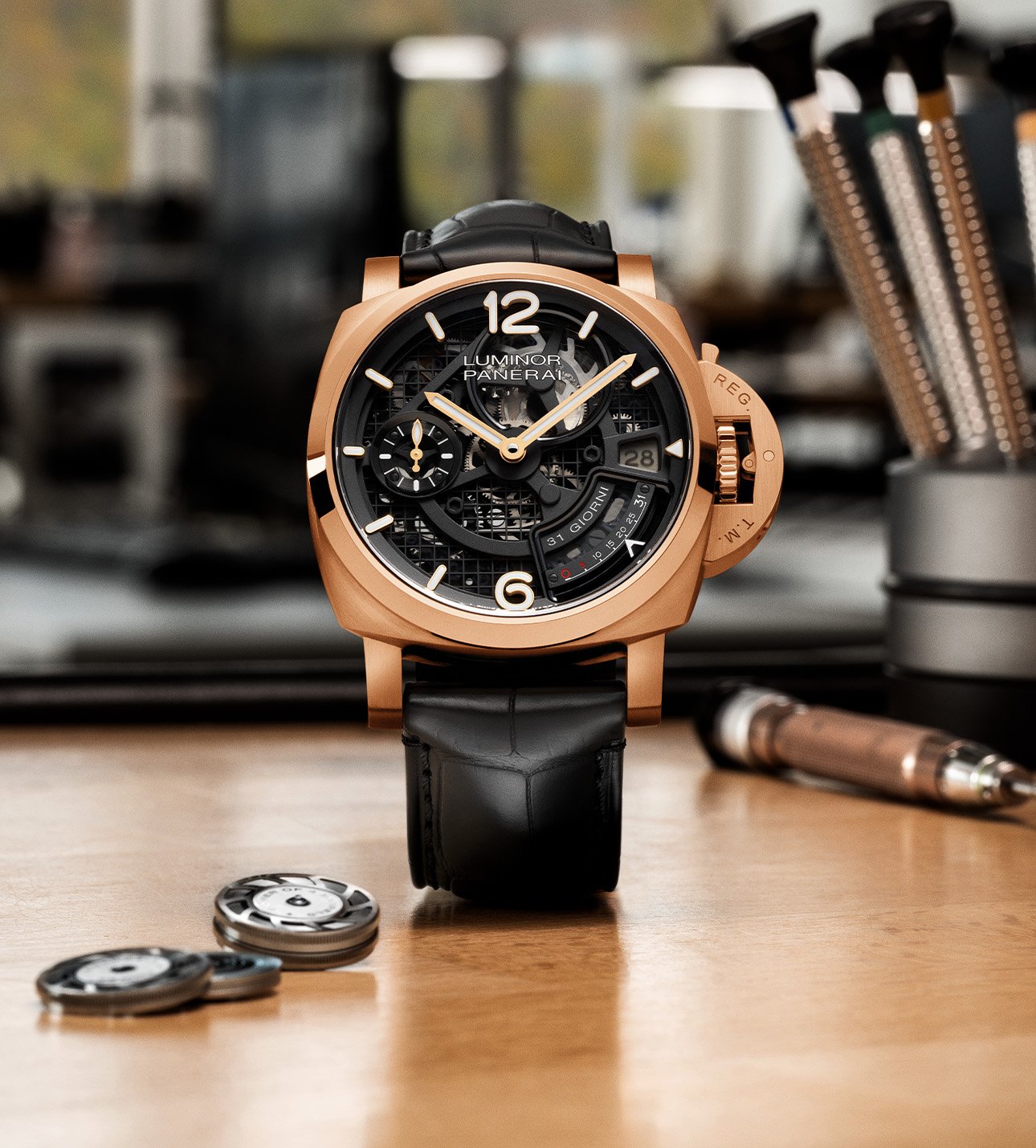
One of this year’s new releases, unveiled at Watches & Wonders in Geneva in April, is the Luminor 31 Giorni (ref. PAM01631), which offers something as unusual as a 31-day power reserve. In other words, when fully wound, it can keep ticking for an entire month without needing to be wound again. That is a record even for Panerai, a brand known for movements with an eight-day power reserve. The 31 days of running time are achieved with the manually wound calibre P.2031/S, featuring no fewer than four mainsprings, compared with the usual one or, at most, two. The watch itself measures 44 mm and is made from Goldtech™, Panerai’s proprietary gold alloy. The price for the
From Combat Diver to Design Icon
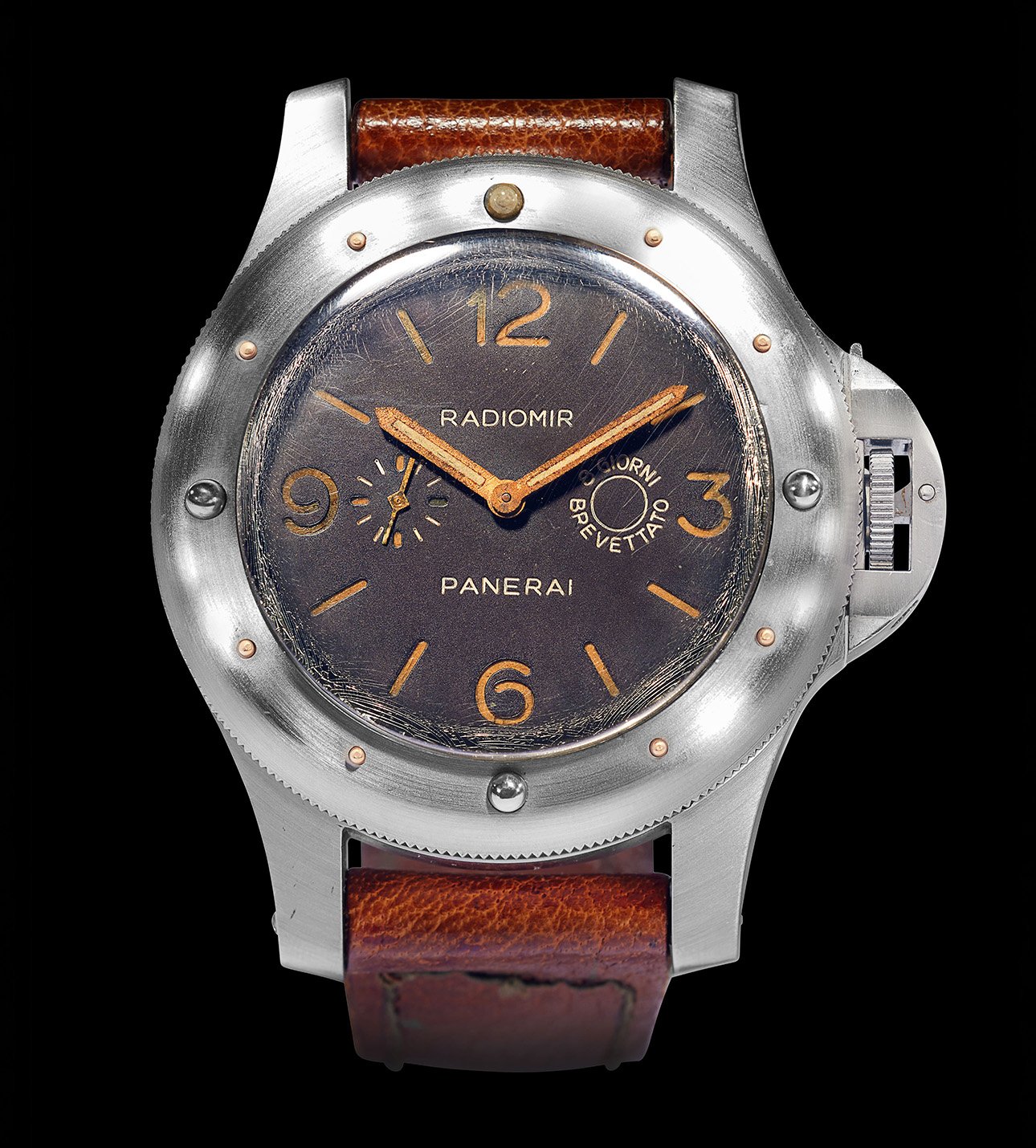
We begin the tour with a history lesson. In 1860, Giovanni Panerai opened the doors to a watch shop in Florence, which later developed into the city’s first watchmaking school. For many years, the business primarily focused on repairing and servicing watches, but towards the end of the century, the Italian military approached the company for assistance with measuring instruments for the navy, and this development intensified over the following decades. In 1916, Panerai patented Radiomir – a radium-based luminous substance that made it possible to read dials in the dark, something no one else could offer at the time.
In 1935, the navy requested a large, robust wristwatch capable of accompanying its elite units on operations at sea. For this purpose, Panerai turned to Rolex, which had already developed its waterproof Oyster case in 1926. Rolex enlarged the model and fitted it with a pocket-watch movement (calibre 618), after which Panerai added its luminous dial. The first Radiomir prototype was born.
In 1938, Panerai introduced an improved Radiomir featuring what is now the brand’s iconic sandwich dial: two overlapping plates with luminous radium between them, visible through cut-outs that form the hour markers.
After the end of the war, cooperation with the navy declined. However, in 1949 Panerai introduced the Luminor model with a tritium-based luminous substance to replace radium, which by then had been discovered to be harmful to health.
Decades of Slumber – and a Rebirth in 1993
As the navy’s need for watches declined in the post-war period, Panerai asked for permission to manufacture watches for the private market. Permission was granted, marking the beginning of a new era for Panerai. With new management at the helm, the company held a spectacular launch on 10 September 1993 aboard the destroyer Durand de la Penne, where the Luminor 5218-201/A and Mare Nostrum 5218-301/A were presented as the first Panerai watches available to the public.
Over lunch, Panerai CCO Jérôme Cavadini explains the beginnings of modern Panerai: “When the first Panerai cases appeared in production, everyone looked at them as if they were UFOs. They were enormous and completely different from the trend at the time, when everything was about small and ultra-thin watches – so honestly, not many people believed Panerai would become a success.”
They could hardly have been more wrong. The watches became a sensation almost overnight precisely because they were large, uncompromising and masculine. Hollywood star Sylvester Stallone also took notice while filming the action movie Daylight in Italy that same year. He wandered into the shop in Florence and bought a Panerai watch, which he subsequently wore throughout much of the film. Priceless marketing.
Another place where Panerai’s rebirth attracted attention was in the executive offices of Vendôme, the luxury group that would eventually become what we know today as the Richemont Group. The company recognised the potential and acquired Panerai in 1997 for US$1 million – which, with the benefit of hindsight, must be considered something of a bargain.
“Honestly, not many people would have bet on Panerai in the beginning. But things took off very quickly, with double-digit growth year after year. There was clearly an audience for these unconventional watches – not least because they had such a strong and coherent history. For us, it is still about finding the balance between Italian design and Swiss technology – and that combination works extremely well,” explains Jérôme Cavadini.
“Panerai has always been an engineering company. Design has never simply been about aesthetics – it has always been closely linked to function. If you look at our history, every detail was created to solve a problem.”
Jérôme Cavadini
FACTS! Did You Know?
- “Paneristi” is the official term for a Panerai fan. The self-organised, community-driven group consists of around 30,000 watch enthusiasts worldwide who meet annually to network and exchange stories. This year, the gathering takes place in Geneva in October, and everyone is welcome.
- Film star Sylvester Stallone was one of the first celebrities to embrace Panerai in the 1990s. He was so enthusiastic about the watches that he wore one in the 1996 film Daylight.
- Other famous Panerai enthusiasts include Jason Statham, Arnold Schwarzenegger and Denmark’s own James and Adam Price, who can regularly be seen cooking with a Panerai on their wrists.
From Raw Metal to DKK 300,000 of Luxury
Together with Leana, I step into Panerai’s large production hall, where CNC milling machines operate around the clock, cutting baseplates and bridges from raw blocks of metal. The baseplate is the piece of brass onto which the components of the movement will later be mounted, so it is crucial that every single screw hole is machined with micrometre precision. Processing just one baseplate can take hours. It must then be washed, ground, polished and, if required, decorated before it is ready for the next stage. It is therefore a long journey from raw brass and steel to the finished watch.
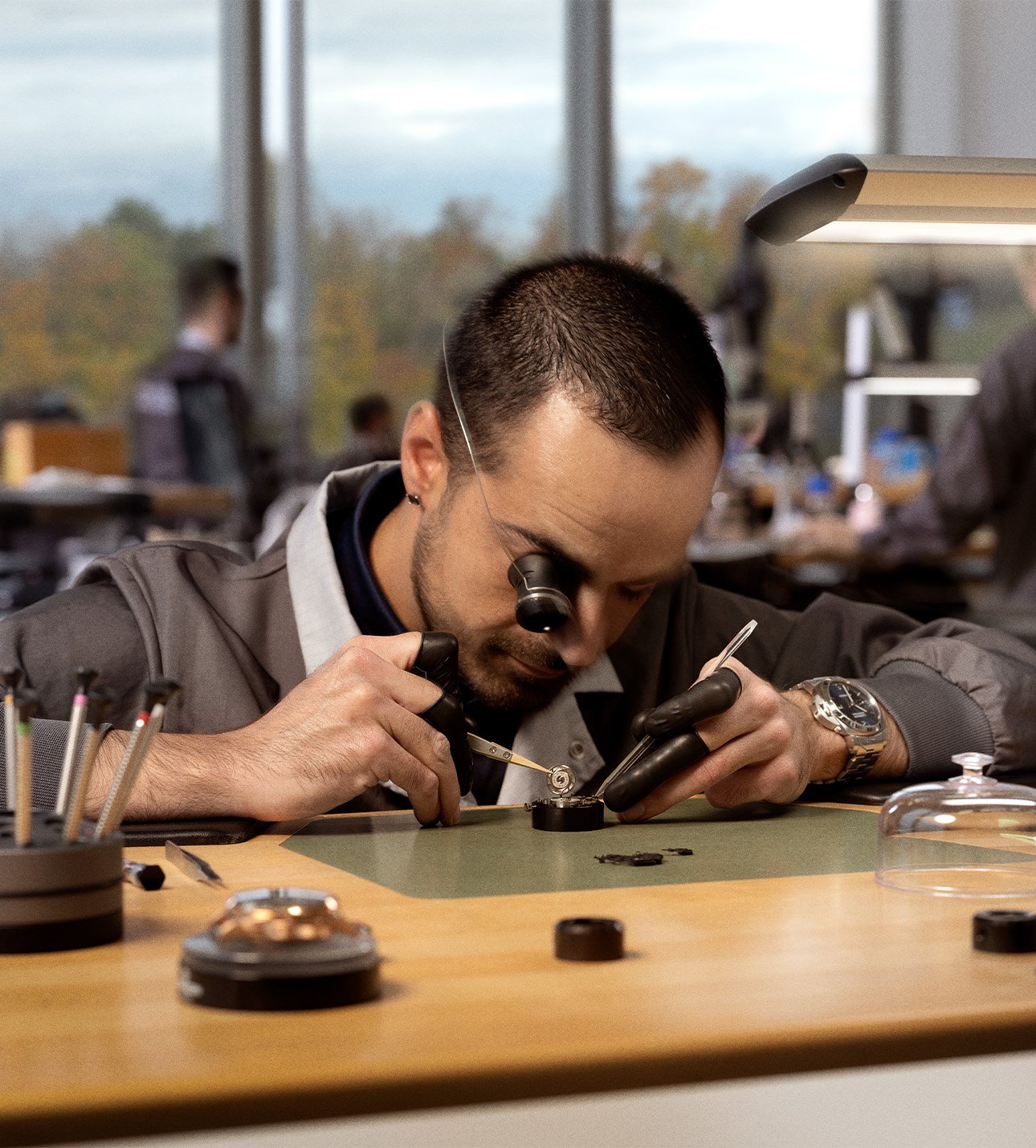
The next section of the production facility feels more like a traditional watchmaking workshop, where a row of watchmakers sit assembling the typically two to three hundred components into finished movements before enclosing them in glass and cases.
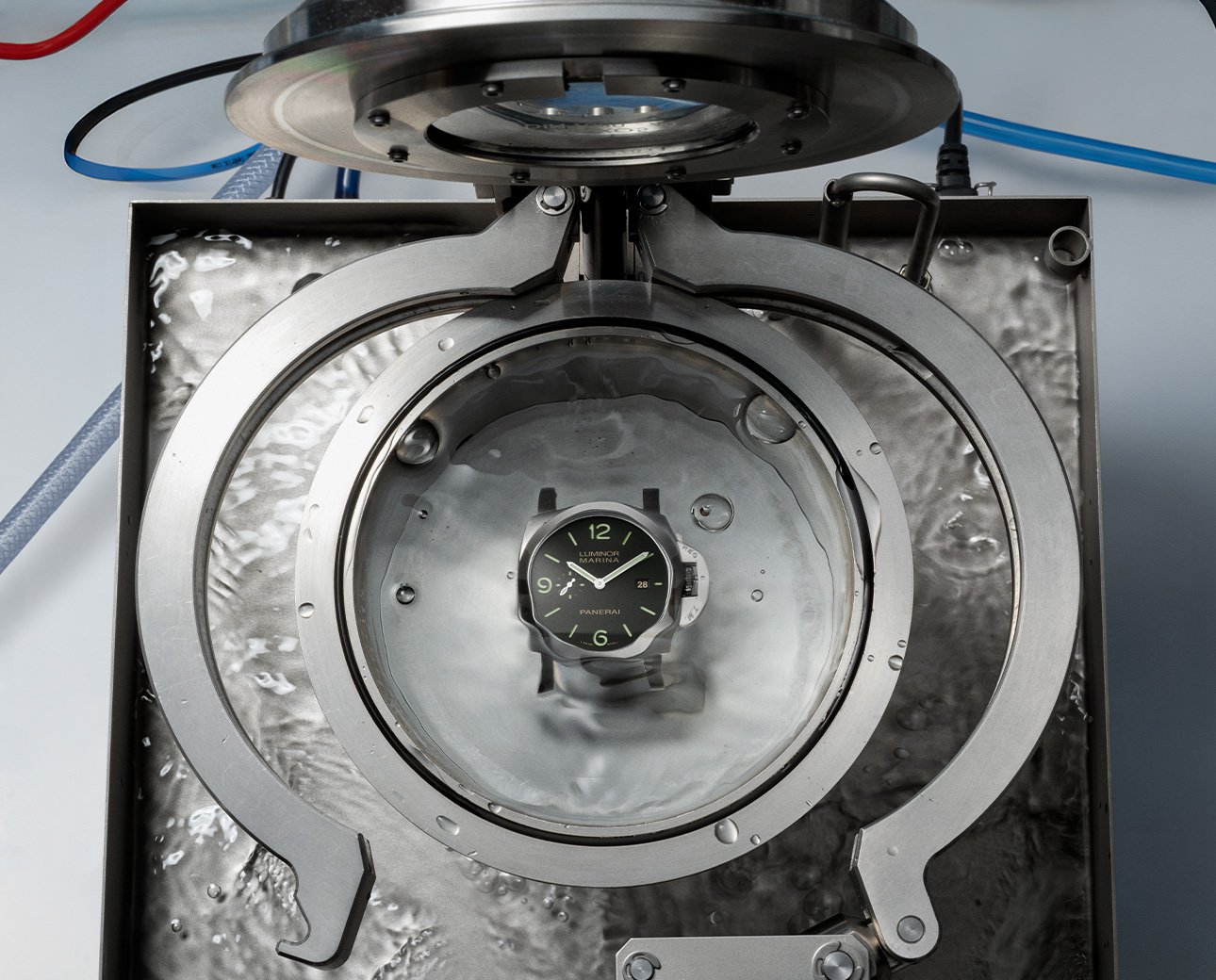
Further down the building, the quality-control department repeatedly tests water resistance, precision and shock resistance. Because when the customer ultimately receives a watch costing DKK 100,000 or 300,000, there can be no room for even the slightest imperfection in its finish, durability or movement accuracy.
“Panerai has always been an engineering company. Design has never simply been about aesthetics – it has always been closely linked to function. If you look at our history, every detail was created to solve a problem,” says Jérôme Cavadini.
The framework for design development at Panerai is therefore actually quite clearly defined: the focus is on large watch cases, high legibility and a functional aesthetic. But within those parameters, there is still room for innovation.
“It is about staying within Panerai’s territory and DNA while constantly improving what we can: water resistance, luminescence, power reserve and precision. Even when we make a perpetual calendar, it has to be easy to read and use.”
Nine Years to Create a Watch
Although the design language is relatively well established, developing new functions and models still takes a considerable amount of time.
“When you develop a movement with around 600 components, you can simulate a great deal, but there are always things you only understand once you build it physically. The first prototype is almost never the right one. That is why developing a new movement can take four to five years,” says Jérôme Cavadini.
And sometimes even longer. One of the projects that stands out most clearly in his memory is the eLux model.
“It was like a nine-year pregnancy. We started with a pretty wild idea: Can you illuminate a watch underwater without a battery? At the time, the micro-LEDs we needed did not actually exist yet. We regularly had to defend the project because many people doubted that it would work.”
In the end, however, it did work. In 2024, Panerai introduced the Submersible Elux Lab-ID PAM01800, whose mechanical movement contains six spring barrels, four of which are dedicated exclusively to the lighting system. Pressing a pusher at eight o’clock releases mechanically stored energy to an internal microgenerator, which converts it into electricity and illuminates 160 micro-LEDs positioned in the hour markers, hands and bezel – entirely without a battery.
“The story never stops. We are constantly building on what we have already created. It is not just about selling watches. It is about developing technologies that we can later bring into the collection. It is a bit like Formula 1 – what starts there eventually finds its way into an ordinary car,” concludes Jérôme Cavadini.